Featured essay
The AI takeover nobody announced
What's actually happening to sales, marketing, and operations right now.
Chaos is every business's default setting. I replace it with systems that run themselves.
There's AI that makes things — a caption, a logo, a cold email. Then there's AI that runs things — your sales, your marketing, your books, your front desk, working through the night without you standing in the middle of it.
That second kind has a name. I wrote the book on it, and I run my companies on it.
Explore Operational AI →Everything I teach, I built first — across my own companies, on my own dime.
 The operating system
Done-for-you AI that runs your operation — installed on your own server, wired to your tools.
 The agency
Where businesses get their systems built — websites, brand, and growth.
 The build shop
Where the software gets engineered, wired, and shipped.
 Demand & growth
Growth engineered — not guessed.
 The books
Bookkeeping & financial operations for owners who'd rather build than reconcile.
Always buildingI'm always building. This is where the next one shows up.





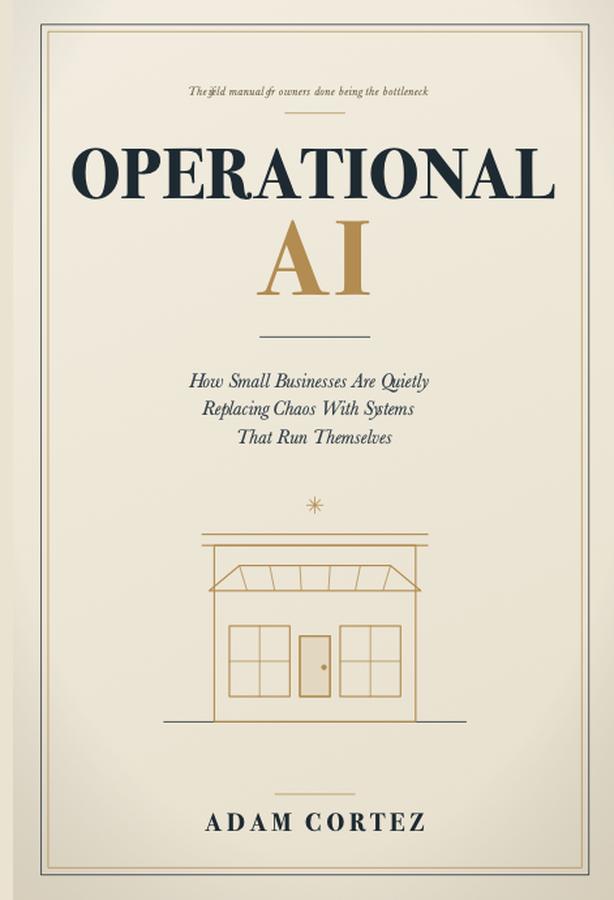
How Small Businesses Are Quietly Replacing Chaos With Systems That Run Themselves.
See the books →
The #1 international bestseller. My chapter — "From Overnight Success to Rock-Bottom."
See the books →What I did next — one backpack, a year around the world, and a decision to create myself instead of find myself — is the reason I build what I build.
New videos and essays on what's actually happening to sales, marketing, and operations — and what to do before it happens to you.
What's actually happening to sales, marketing, and operations right now.
Why every business trends toward chaos, and the systems that reverse it.
I learned that the hard way. Here's the version I don't usually lead with.
I dropped out of college, started brokering deals between investors and startups, and closed a partnership worth $300 million. Then I did what a 21-year-old with more luck than wisdom does: I spent like the check had already cleared. Designer suits, exclusive clubs, and a lot of bragging. When the deal fell through, I had nothing left but red numbers and a very loud ego. I hit rock bottom.
Rock bottom has one silver lining: you've got nothing left to protect. So I sold what I had, packed one backpack, and spent a year traveling the world — funding it with the web-design skills I'd been building since high school — starting with ten days of silent meditation, no phone, no talking, no hiding. I came back a different person. Not fixed. Rebuilt.
My dad ran his own business, and I've been making websites since I was a teenager. After that year, I finally pointed all of it at one thing: helping owners get out from under the chaos of their own companies. That became ARC. Then it became a lot more.
Fifteen-plus years later, I build the systems that let businesses run without their owners drowning — and I've turned that into a family of companies, two books, and a body of work I call Operational AI. Same move every time, whether it's my life or your business.
I also serve as board chairman of Soul Shoppe, a social-emotional learning nonprofit that's spent 20+ years teaching kids the tools to name their emotions, work through conflict, and treat each other well. The whole point of building leverage is having something left to give.
The AI that runs the business — not just the AI that writes the email.
For years, "AI for business" meant a tool that helped you make something faster. That era is over. The real shift is AI that takes the work itself off your plate — sales that follows up on its own, marketing that ships without a meeting, books that reconcile overnight, a front desk that never sleeps.
That's Operational AI, and it's already quietly replacing chaos inside businesses that most people would call "small."
No code, no jargon, no fantasy where you flip a switch and it's done by Friday. Just the diagnosis, the idea, and a department-by-department walk through a business that runs itself.
Get the book — coming soonEvery week I take one piece of the business — a department, a task, a myth — and show exactly how AI is taking it over.
Longer-form thinking for owners who want the why under the how.
How AI quietly seized sales, marketing, and operations — and what owners do now.
EssayWhy every business trends toward chaos, and the systems that reverse it.
EssayWhere all of this breaks, and the lines I won't cross — because trust beats dazzle.
EssayWhy hiring, buying software, and working harder don't fix the real problem.
One's the man. One's the method. Read them in either order.
How Small Businesses Are Quietly Replacing Chaos With Systems That Run Themselves. The book for the owner who's become the bottleneck — written for the ones answering email at 11 p.m., wondering why winning still feels like drowning.
Buy now — coming soonContributing author: "From Overnight Success to Rock-Bottom." My chapter is the honest account of losing $300M and everything after — the story behind everything I build now.
Get the book (opens in a new tab)One operator, one philosophy, a growing family of companies.
The operating systemThe operating system for a business that runs itself. Done-for-you AI that runs your operation, installed on your own server.
caiossoftware.comThe agencyThe agency where businesses get their systems built — websites, brand, and growth.
arccreativeco.comThe build shopWhere the software gets engineered, wired, and shipped.
arclabsventure.comDemand & growthDemand and growth, engineered — not guessed.
xceleratedmedia.comThe booksThe books, done right and done on time. Bookkeeping & financial operations for owners who'd rather build than reconcile.
steingardfinancial.comI'm always building. This is where the next one shows up.
I've closed nine-figure deals, lost everything, and rebuilt it into a company you can run from your phone. I talk about all of it.
How AI quietly seized sales, marketing, and operations — and what owners do now.
Why every business trends toward chaos, and the systems that reverse it.
The comeback keynote: ego, failure, and rebuilding yourself on purpose.
You already know which part of your business is held together by a spreadsheet and somebody's memory. I build the tool that replaces it — and I hand it over working, monitored, and documented.
I am not going to hand you a strategy deck. I run five companies on software I wrote, and every pattern in this programme is one I use on myself first — the outreach engine that fills my pipeline, the update system that keeps a hundred client installs current, the monitoring that tells me something broke before a client notices.
That is the whole pitch. I am a builder who happens to own businesses, which means I have already made the expensive mistakes on my own dime. You get the version that came after them.
Somebody on your team already built the thing in a weekend of prompting. It ran once, in front of you, and it was genuinely impressive. Then it hit real data and stopped — quietly, in a way nobody noticed for three weeks. A prototype proves an idea is possible. It does not survive being depended on.
I write the spec, the architecture and the proof path — what it does, what it talks to, what it must never do, and the test that proves it works. Most of the value of the whole month is decided here.
A deployed, tested tool on a real URL with real data. Not a demo on my laptop. You use it, you break it, and I fix what you broke before we go further.
A marketing page for the tool and a written case study of the build. If it is internal, this is what gets your team to actually adopt it.
Hardening, documentation, the GitHub repo handed to you, and the tool enrolled in Fleet Health monitoring and The Hold update train. This is the milestone that decides whether you still have a working tool next year.
One fee, four equal payments, each released against a milestone you can see working. If I stall, you stop paying at the last thing that shipped.
These are not client case studies. They are the tools I depend on to run my companies, built exactly the way yours will be.
My own cold outreach system, end to end. Drydock owns the sending infrastructure — separate domains, individual mailboxes, warm-up and a kill switch. Armada sits above it: lead import, enrichment, drafting, a human review gate, then send.
The control plane that keeps every deployed tool current. A release is promoted once and every install pulls it — the installs reach out, the control plane never reaches in. A client box can sit behind a firewall I have no access to and still never miss a release.
The thing that tells me a tool broke before you notice. Every service reports in on a schedule, and a service that goes quiet is treated as failed rather than assumed fine — including the ones that die silently, which is the failure mode that otherwise sits undetected for weeks.
The audit stands on its own. The build stands on its own. The retainer is for people who would rather not think about it again.
$250 one off
The diagnostic. Worth doing even if you never build anything with me.
$5,800–$9,800 by scope
Paid in four equal milestones, each released against working software.
$900–$2,500 per month
$900 for new founders, $2,500 standard. Only offered after a build.
A build is $5,800 when the tool is one job done well against systems that already have an API. It moves toward $9,800 when it has to talk to several systems, hold state that matters, or be used by people outside your company. The audit is what tells us which of those you have.
It is the number I work to, measured from a signed proposal rather than the first conversation. It holds because the scope is fixed at the audit instead of discovered halfway through, and because I am building on a stack I already run. What moves the date is almost always access — an account I am waiting on, or a decision only you can make. I will tell you on the day it happens rather than at the end.
The GitHub repository, the deployed tool, the documentation, the landing page and the case study. It is your code in your repository. If you walk away the next day the tool keeps running and somebody else can pick it up — that is the point of the documentation milestone.
A worked map of where your operating hours go, the bottlenecks ranked by cost, and one scoped build proposal. It is a real piece of work, not a sales call with a price on it — including the part where I tell you a bottleneck is not worth a tool. If you take the proposal to somebody else to build, that is allowed.
No. It is offered after a build, not before, and plenty of builds end at handover. Take it if you would rather not think about monitoring, updates and marketing again; skip it if you have people who will.
On a retainer, Fleet Health tells me before you notice and it is my problem. Without one you still have the repository, the documentation and the monitoring config, and you can come back to me for the fix at my normal rate. What you will not have is me watching it for you.
No. Consulting ends in a document. This ends in software running on a URL, in your repository, with monitoring on it. The audit is the only part that produces a document, and it exists to decide what gets built.
Tell me what your business does and which part of it is currently done by hand. If I think there is nothing here worth building, I will say that instead — it is a shorter call and we both keep our afternoon.
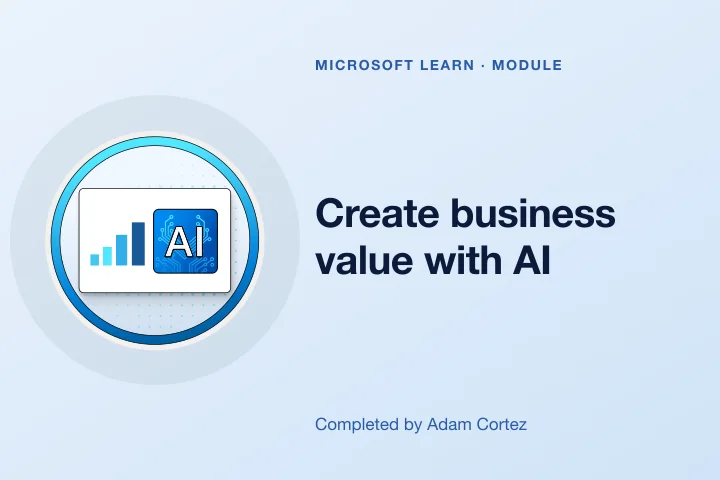
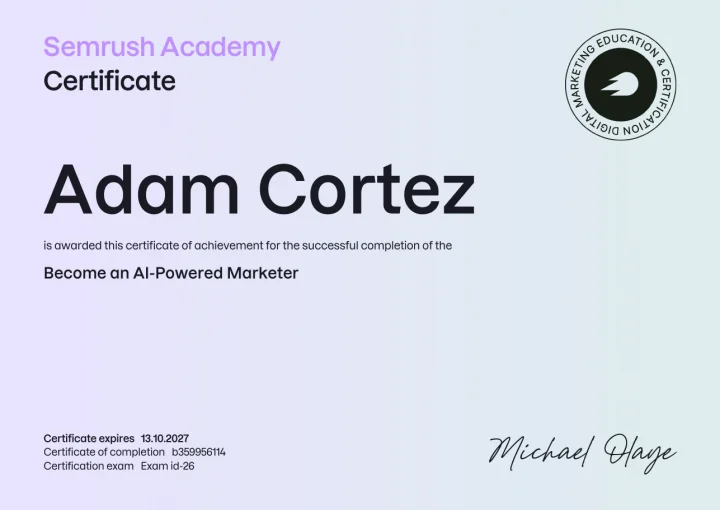
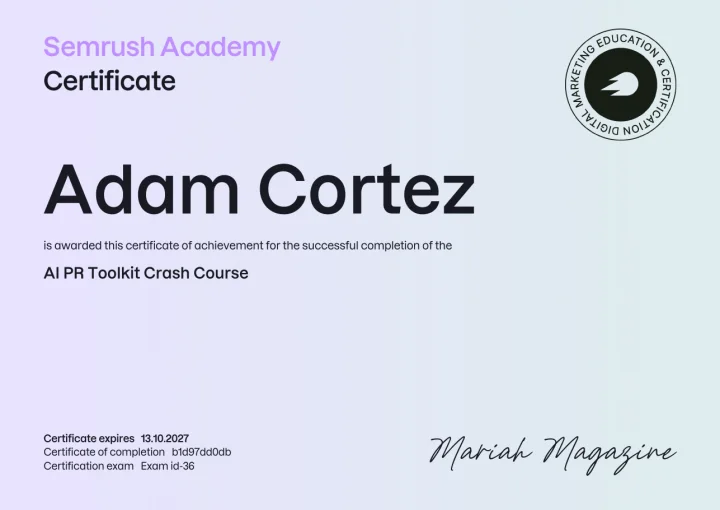
Operational AI changes every week, so I keep learning it at the source — 64 courses from Anthropic, OpenAI, Microsoft, HubSpot, and Semrush so far. Click any badge to see it, or verify it with the issuer.
Point me at the right door and I'll get back to you.
Ready to take yourself out of the middle of your business? Let's talk about installing the system.
Book a callStart with the $250 AI Tool Gap Audit, or book fifteen minutes and we will work out whether there is a build here at all.
hello@adamcortez.com →Keynotes on Operational AI, chaos-to-systems, and the comeback story.
See talks